Article 3: Bidding and Buying
Business Education
March 22, 2019
So, now we have talked about business models, let’s take a look at how the process of actually buying items and placing bids and winning auctions works. Many liquidators operate on a simple buy-now format, and/or a traditional auction format, so we will discuss both here.
The first thing you need to do is find your way around the listings. Almost every liquidation website uses interactive menus, allowing you to focus your searches on what you are looking for.
Many liquidation marketplaces allow you to perform advanced searches, allowing you to choose pallet locations, and then refine your search further, for example, by sorting by a particular brand or category. You will likely want to choose the closest location to you, to save on shipping costs.
For example, you may be able to search by Brand, Vendor (the retailer liquidating the goods) or by Location combined, to help narrow down results to those that would help your business model the most. This means you can search for products from a certain retailer that fit a certain category, and also by their current location, all as a single advanced search.
Let’s take a look at an example listing, one from Direct Liquidation, to see what you can see on the screen:
 Legend
A - Current category
B - Vendor - the retailer liquidating the products
C - Time left in the auction
D - The current bid value
E - The recommended retail value of the products if new, and the average per item
F - Brief description of lot
G - Summary of item size, location and condition
H - Number of items that can be described best by each category and brand
I - Link to download the full manifest for the pallet/s
Many lots you’ll see for sale on liquidation websites are in a simple “Buy Now” format. Once you commit to buying one of these lots, you can purchase it immediately at the marked price. Many others use an auction format, and others use a combination of the two formats.
Let’s talk about how the auction process actually works. If you have found a listing that you like, and would like to start the buying process, you should first calculate the maximum bid that you would be happy to spend, giving you enough scope for profits.
Let’s consider what factors you need to take into account when you calculate your maximum bid, or when deciding if an instant-buy price is worth it for you, as it is as important to work out your costs for a buy-now item as for an auction.
Look out for manifests on the listings. A manifest is a catalog of the contents of each pallet, or lot. The manifest will contain a list of every item included and its condition, as well more information such as model numbers and the UPC (Universal Product Code - the number held within the barcode), and it’s original MSRP (the retail price). This information can be used to help you research the items, and what the resale value is based on their condition.
Legend
A - Current category
B - Vendor - the retailer liquidating the products
C - Time left in the auction
D - The current bid value
E - The recommended retail value of the products if new, and the average per item
F - Brief description of lot
G - Summary of item size, location and condition
H - Number of items that can be described best by each category and brand
I - Link to download the full manifest for the pallet/s
Many lots you’ll see for sale on liquidation websites are in a simple “Buy Now” format. Once you commit to buying one of these lots, you can purchase it immediately at the marked price. Many others use an auction format, and others use a combination of the two formats.
Let’s talk about how the auction process actually works. If you have found a listing that you like, and would like to start the buying process, you should first calculate the maximum bid that you would be happy to spend, giving you enough scope for profits.
Let’s consider what factors you need to take into account when you calculate your maximum bid, or when deciding if an instant-buy price is worth it for you, as it is as important to work out your costs for a buy-now item as for an auction.
Look out for manifests on the listings. A manifest is a catalog of the contents of each pallet, or lot. The manifest will contain a list of every item included and its condition, as well more information such as model numbers and the UPC (Universal Product Code - the number held within the barcode), and it’s original MSRP (the retail price). This information can be used to help you research the items, and what the resale value is based on their condition.
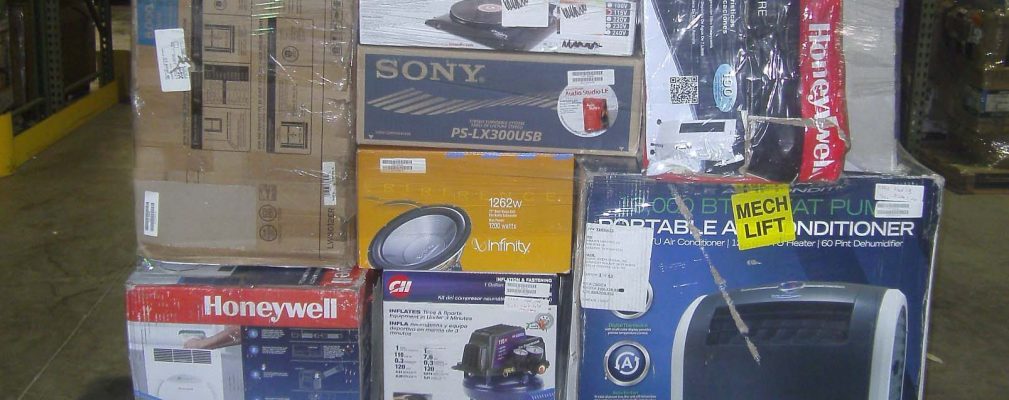 You should be aware when buying a pallet that 10-20% of the items may not have any resale value at all. Usually, these were low-value items to begin with, that nobody is going to want to buy used. You may be able to salvage some value from them via a discount bin in-store or at a flea market, but most other business models aren’t going to reach out to people that want these items. This has to be taken into account in your calculations.
We recommend that you create a spreadsheet in a program like Microsoft Excel to make your profitability calculations. Don’t simply use a calculator and notepad. This way, you can create a template, and simply change the inputs for each different lot you are looking at. This can also help you make the decision as to whether it is worth taking the time to pick up items yourself, as you can see the difference in profitability immediately.
To start with, consider the costs of transportation, and of any overheads you will have, such as renting storage space. These costs are more or less fixed, so can be added immediately. As for calculating the resale value for each item, it is a good idea when looking at pallets to take the cheapest items, those with a retail price of less than $50, and just round them down to something like $20, to be conservative. Calculating the value of everything else is easier if you have a pallet of very similar items, as you can just take an average for the selling price of all of them.
Mixed pallets are more difficult. For these, you will have to take all the high-value items, and research, using their product codes or model numbers, what the resale price roughly is in their current condition, by searching online. You can then estimate or completely discount the low-cost items. This is a bit more labor-intensive. But without this research, you will not have any educated idea as to what your maximum bid should be on the lot to preserve enough profit for this to be worth it.
Next, you need to calculate the costs of any repairs that you need to do, and tools you might need to do this, if you don’t have them already.
Here is an example of how you could process this lot in a spreadsheet for 4 different business models, and how each one affects what your profitability would be for a certain maximum bid price.
You should be aware when buying a pallet that 10-20% of the items may not have any resale value at all. Usually, these were low-value items to begin with, that nobody is going to want to buy used. You may be able to salvage some value from them via a discount bin in-store or at a flea market, but most other business models aren’t going to reach out to people that want these items. This has to be taken into account in your calculations.
We recommend that you create a spreadsheet in a program like Microsoft Excel to make your profitability calculations. Don’t simply use a calculator and notepad. This way, you can create a template, and simply change the inputs for each different lot you are looking at. This can also help you make the decision as to whether it is worth taking the time to pick up items yourself, as you can see the difference in profitability immediately.
To start with, consider the costs of transportation, and of any overheads you will have, such as renting storage space. These costs are more or less fixed, so can be added immediately. As for calculating the resale value for each item, it is a good idea when looking at pallets to take the cheapest items, those with a retail price of less than $50, and just round them down to something like $20, to be conservative. Calculating the value of everything else is easier if you have a pallet of very similar items, as you can just take an average for the selling price of all of them.
Mixed pallets are more difficult. For these, you will have to take all the high-value items, and research, using their product codes or model numbers, what the resale price roughly is in their current condition, by searching online. You can then estimate or completely discount the low-cost items. This is a bit more labor-intensive. But without this research, you will not have any educated idea as to what your maximum bid should be on the lot to preserve enough profit for this to be worth it.
Next, you need to calculate the costs of any repairs that you need to do, and tools you might need to do this, if you don’t have them already.
Here is an example of how you could process this lot in a spreadsheet for 4 different business models, and how each one affects what your profitability would be for a certain maximum bid price.
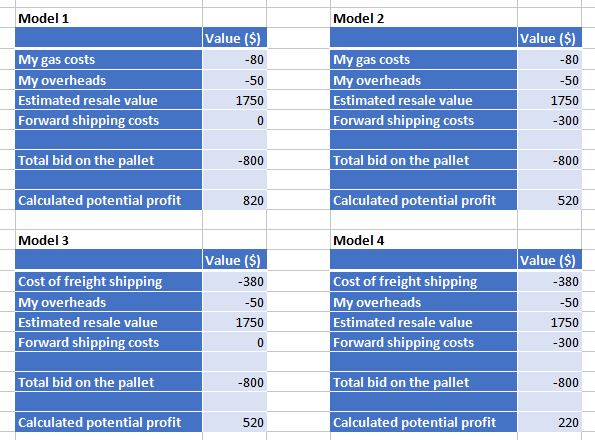 Model 1 shows numbers for a business where you pick up the product yourself and sell locally, with no associated forward-delivery costs. Model 2 shows the same, but for an online business with these forward-delivery costs. Model 3 shows you using a freight shipping service to get the product to your address, to then sell locally. Model 4 shows a business that uses a freight shipping service to acquire the goods, then uses couriers to deliver them to the end customers.
As you can see, the profitability of each model changes. For Model 1, you may want to increase your maximum bid on the pallet. For Model 4, you probably will want to decrease your maximum bid, for your time-investment to be worth it. If you require a profit of around $400 on this pallet, you would change your maximum bid as part of Model 1 to $1220, in Models 2 and 3 to $920, but for Model 4 your maximum bid should be $580. This large difference shows the importance of planning.
Once you have calculated what your maximum bid on the lot should be, stick to it. When you enter a maximum bid, websites with a proxy-bidding system will gradually increase the bid up to this limit as other people bid. You may not have to pay the maximum bid, if you have no competition. You will only pay as much as the highest bid at the end of the auction. Other websites may make you bid manually, so check out the instructions on the site you are using.
The key here is to walk away once you have chosen your top bid. Don’t get caught up in the moment, and continue to add more to stay in the lead. If you have calculated the maximum you are able to spend in order to make a worthwhile profit, stop there. Someone else may have different overhead, so don’t think you can always compete. Once you have made a decision, stick with it.
Once the timer has run out, and you’re the highest bidder, you have won the item for the stated price that the bids have reached.
Auctions have a time limit. Once that limit is reached and you are the highest bidder, you will get a notification that you have won the auction. You will then be instructed on how to complete payment. Most websites accept credit cards, and direct bank transfers.
Once you have won an auction or bought a lot directly, you will likely get an email explaining what steps to take next. You may also be contacted regarding shipping arrangements for your order. For example, if you’re shipping with Direct Liquidation, you will then get tracking and status updates. Whoever you buy from, you will also be prompted to make your final payment. It is a good idea to make sure at this stage that all of your contact and delivery details are up-to-date and correct.
Most liquidators don’t ship overnight. You may have to wait somewhere between 5-14 days for delivery. Also bear in mind that you will need time to check through and prepare the items for onward sale, including repackaging, before you list them or place them on a stall. Most vendors will also not release items until payment has been fully cleared. Don’t expect everything to be done overnight. There may be a month or longer between purchase and resale.
In the next article, we will talk about shipping considerations.
Model 1 shows numbers for a business where you pick up the product yourself and sell locally, with no associated forward-delivery costs. Model 2 shows the same, but for an online business with these forward-delivery costs. Model 3 shows you using a freight shipping service to get the product to your address, to then sell locally. Model 4 shows a business that uses a freight shipping service to acquire the goods, then uses couriers to deliver them to the end customers.
As you can see, the profitability of each model changes. For Model 1, you may want to increase your maximum bid on the pallet. For Model 4, you probably will want to decrease your maximum bid, for your time-investment to be worth it. If you require a profit of around $400 on this pallet, you would change your maximum bid as part of Model 1 to $1220, in Models 2 and 3 to $920, but for Model 4 your maximum bid should be $580. This large difference shows the importance of planning.
Once you have calculated what your maximum bid on the lot should be, stick to it. When you enter a maximum bid, websites with a proxy-bidding system will gradually increase the bid up to this limit as other people bid. You may not have to pay the maximum bid, if you have no competition. You will only pay as much as the highest bid at the end of the auction. Other websites may make you bid manually, so check out the instructions on the site you are using.
The key here is to walk away once you have chosen your top bid. Don’t get caught up in the moment, and continue to add more to stay in the lead. If you have calculated the maximum you are able to spend in order to make a worthwhile profit, stop there. Someone else may have different overhead, so don’t think you can always compete. Once you have made a decision, stick with it.
Once the timer has run out, and you’re the highest bidder, you have won the item for the stated price that the bids have reached.
Auctions have a time limit. Once that limit is reached and you are the highest bidder, you will get a notification that you have won the auction. You will then be instructed on how to complete payment. Most websites accept credit cards, and direct bank transfers.
Once you have won an auction or bought a lot directly, you will likely get an email explaining what steps to take next. You may also be contacted regarding shipping arrangements for your order. For example, if you’re shipping with Direct Liquidation, you will then get tracking and status updates. Whoever you buy from, you will also be prompted to make your final payment. It is a good idea to make sure at this stage that all of your contact and delivery details are up-to-date and correct.
Most liquidators don’t ship overnight. You may have to wait somewhere between 5-14 days for delivery. Also bear in mind that you will need time to check through and prepare the items for onward sale, including repackaging, before you list them or place them on a stall. Most vendors will also not release items until payment has been fully cleared. Don’t expect everything to be done overnight. There may be a month or longer between purchase and resale.
In the next article, we will talk about shipping considerations.
Legend
A - Current category
B - Vendor - the retailer liquidating the products
C - Time left in the auction
D - The current bid value
E - The recommended retail value of the products if new, and the average per item
F - Brief description of lot
G - Summary of item size, location and condition
H - Number of items that can be described best by each category and brand
I - Link to download the full manifest for the pallet/s
Many lots you’ll see for sale on liquidation websites are in a simple “Buy Now” format. Once you commit to buying one of these lots, you can purchase it immediately at the marked price. Many others use an auction format, and others use a combination of the two formats.
Let’s talk about how the auction process actually works. If you have found a listing that you like, and would like to start the buying process, you should first calculate the maximum bid that you would be happy to spend, giving you enough scope for profits.
Let’s consider what factors you need to take into account when you calculate your maximum bid, or when deciding if an instant-buy price is worth it for you, as it is as important to work out your costs for a buy-now item as for an auction.
Look out for manifests on the listings. A manifest is a catalog of the contents of each pallet, or lot. The manifest will contain a list of every item included and its condition, as well more information such as model numbers and the UPC (Universal Product Code - the number held within the barcode), and it’s original MSRP (the retail price). This information can be used to help you research the items, and what the resale value is based on their condition.
You should be aware when buying a pallet that 10-20% of the items may not have any resale value at all. Usually, these were low-value items to begin with, that nobody is going to want to buy used. You may be able to salvage some value from them via a discount bin in-store or at a flea market, but most other business models aren’t going to reach out to people that want these items. This has to be taken into account in your calculations.
We recommend that you create a spreadsheet in a program like Microsoft Excel to make your profitability calculations. Don’t simply use a calculator and notepad. This way, you can create a template, and simply change the inputs for each different lot you are looking at. This can also help you make the decision as to whether it is worth taking the time to pick up items yourself, as you can see the difference in profitability immediately.
To start with, consider the costs of transportation, and of any overheads you will have, such as renting storage space. These costs are more or less fixed, so can be added immediately. As for calculating the resale value for each item, it is a good idea when looking at pallets to take the cheapest items, those with a retail price of less than $50, and just round them down to something like $20, to be conservative. Calculating the value of everything else is easier if you have a pallet of very similar items, as you can just take an average for the selling price of all of them.
Mixed pallets are more difficult. For these, you will have to take all the high-value items, and research, using their product codes or model numbers, what the resale price roughly is in their current condition, by searching online. You can then estimate or completely discount the low-cost items. This is a bit more labor-intensive. But without this research, you will not have any educated idea as to what your maximum bid should be on the lot to preserve enough profit for this to be worth it.
Next, you need to calculate the costs of any repairs that you need to do, and tools you might need to do this, if you don’t have them already.
Here is an example of how you could process this lot in a spreadsheet for 4 different business models, and how each one affects what your profitability would be for a certain maximum bid price.
Model 1 shows numbers for a business where you pick up the product yourself and sell locally, with no associated forward-delivery costs. Model 2 shows the same, but for an online business with these forward-delivery costs. Model 3 shows you using a freight shipping service to get the product to your address, to then sell locally. Model 4 shows a business that uses a freight shipping service to acquire the goods, then uses couriers to deliver them to the end customers.
As you can see, the profitability of each model changes. For Model 1, you may want to increase your maximum bid on the pallet. For Model 4, you probably will want to decrease your maximum bid, for your time-investment to be worth it. If you require a profit of around $400 on this pallet, you would change your maximum bid as part of Model 1 to $1220, in Models 2 and 3 to $920, but for Model 4 your maximum bid should be $580. This large difference shows the importance of planning.
Once you have calculated what your maximum bid on the lot should be, stick to it. When you enter a maximum bid, websites with a proxy-bidding system will gradually increase the bid up to this limit as other people bid. You may not have to pay the maximum bid, if you have no competition. You will only pay as much as the highest bid at the end of the auction. Other websites may make you bid manually, so check out the instructions on the site you are using.
The key here is to walk away once you have chosen your top bid. Don’t get caught up in the moment, and continue to add more to stay in the lead. If you have calculated the maximum you are able to spend in order to make a worthwhile profit, stop there. Someone else may have different overhead, so don’t think you can always compete. Once you have made a decision, stick with it.
Once the timer has run out, and you’re the highest bidder, you have won the item for the stated price that the bids have reached.
Auctions have a time limit. Once that limit is reached and you are the highest bidder, you will get a notification that you have won the auction. You will then be instructed on how to complete payment. Most websites accept credit cards, and direct bank transfers.
Once you have won an auction or bought a lot directly, you will likely get an email explaining what steps to take next. You may also be contacted regarding shipping arrangements for your order. For example, if you’re shipping with Direct Liquidation, you will then get tracking and status updates. Whoever you buy from, you will also be prompted to make your final payment. It is a good idea to make sure at this stage that all of your contact and delivery details are up-to-date and correct.
Most liquidators don’t ship overnight. You may have to wait somewhere between 5-14 days for delivery. Also bear in mind that you will need time to check through and prepare the items for onward sale, including repackaging, before you list them or place them on a stall. Most vendors will also not release items until payment has been fully cleared. Don’t expect everything to be done overnight. There may be a month or longer between purchase and resale.
In the next article, we will talk about shipping considerations.
Ready to start buying?